# How to Stop Your Dog from Pulling on the Leash Now
Walking your dog should be one of the most relaxing and enjoyable parts of your day. However, for many pet owners, that dream quickly turns into a daily battle where their arm is yanked, their dignity is questioned, and the neighborhood looks on in amusement. If you find yourself constantly fighting against a dog who pulls on the leash, you are certainly not alone. The good news is that this behavior is not only correctable but can be eradicated with patience, consistency, and the right strategies.
This comprehensive guide will take you through the psychological and physical reasons why your dog pulls and provide you with a step-by-step roadmap to achieving calm, controlled walks. By the end of this article, you will understand how to transform chaotic outings into serene bonding moments.
## Understanding the Root Causes of Pulling
Before implementing any solution, it is crucial to understand why your dog pulls in the first place. Dogs do not wake up one morning decide to become pullers; their behavior stems from a combination of instinct, training history, and environmental stimuli. Recognizing these underlying causes is the foundation of successful leash training.
### Analyzing Instinctive Behavior
The primary reason dogs pull forward is rooted in basic biology and drive. In a canine world, movement equals opportunity. Every step forward represents a chance to investigate a scent, greet a familiar dog, or explore a new territory. When your dog is attached to a leash, they feel restricted. This restriction often triggers a higher level of urgency to move toward their destination because they know their options are limited by the length of the line.
Furthermore, the physics of walking contributes to pulling. Many dogs simply find it easier to pull. Think of it like a tug-of-war. When a dog leans back and pushes forward, they generate tension. Ironically, this tension often feels rewarding to them because it creates resistance that they can push against, similar to running against a wall. They may not be trying to annoy you; they are simply following their natural impulse to lead and cover ground.
### Addressing Common Owner Mistakes
Sometimes, the problem lies not with the dog, but with the inadvertent training provided by the owner. A major contributor to pulling is inconsistency. If a dog pulls once and gets to the tree to sniff, they learn that pulling works. If you allow pulling on some days but try to stop it on others, the dog becomes confused, much like a slot machine that pays out unpredictably—their behavior continues in hopes of a reward.
Another common mistake is using tight-leash interactions as a signal. If a dog pulls and you tighten the leash, you are engaging in a physical struggle. For a dog, a tug on the collar can sometimes feel like play or chase initiation. Additionally, relying solely on force—jerking the leash or correcting harshly—can create anxiety. An anxious dog often reacts defensively by pulling harder to escape the pressure. Understanding these nuances helps shift the dynamic from "owner versus dog" to "partners in movement."
### Establishing Realistic Expectations
One of the biggest hurdles in training is setting unrealistic timelines. You did not develop years of pulling habits overnight, so you should not expect to fix them in a weekend. Leash manners are a lifelong skill that requires maintenance. Progress is rarely linear; you may have great walks for two weeks, followed by a week of regression due to changes in the environment or weather.
Be prepared for this journey. Accept that progress involves trial and error. If you set realistic goals, such as focusing on getting 10 minutes of loose leash walking before celebrating a success, you protect both your mental peace and your dog’s morale. Remember that the goal is not just obedience, but cooperation. Understanding the root causes empowers you to address the specific triggers unique to your pup.
## Choosing the Right Equipment for Control
While tools do not train your dog by themselves, having the correct equipment makes the job significantly easier. Using the wrong tool can cause physical injury or reinforce bad habits, whereas the right gear supports your training efforts and ensures safety. Let us review the essential tools available to aid training and reduce strain.
### Reviewing Essential Tools: Harnesses vs. Collars
Traditionally, flat buckles and choke chains were common, but modern veterinary science and behavioral experts advise against them for reactive or strong pullers. These collars put immense pressure on the trachea and neck structures. Instead, the industry standard has shifted towards harnesses and specialized restraint systems.
The choice largely depends on your dog's size and energy level. Martingale collars are excellent for sighthounds who might slip out of regular collars, but they do not prevent pulling. For pullers, a well-fitted harness is superior. The key distinction lies in where the leash attaches.
#### The Power of the Front-Clip Harness
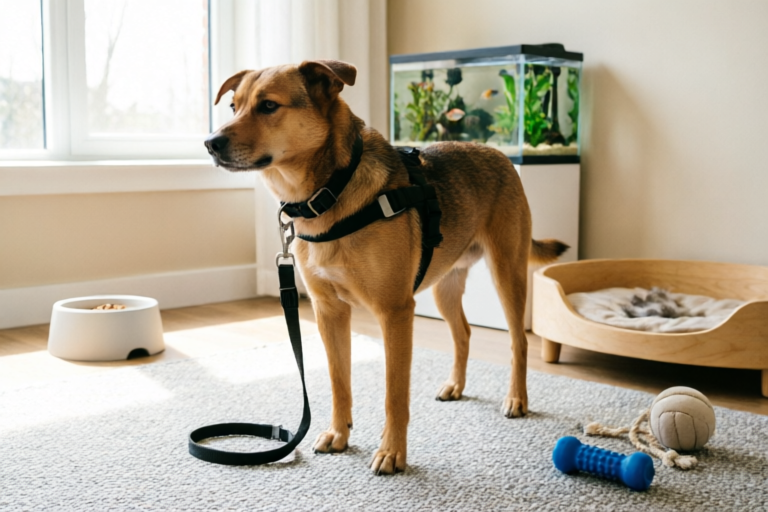
A front-clip harness is arguably the most effective tool for teaching loose leash walking. Unlike a standard harness that clips between the shoulder blades, a front-clip harness has the attachment ring on the chest plate.
When your dog pulls forward and you attach the leash to the chest, the natural physics of the harness causes the dog’s momentum to redirect sideways rather than forward. As soon as they lean against the leash to pull, their own body turns toward you. This is a passive correction mechanism that does not hurt the dog but makes pulling physically uncomfortable or impossible for them. Over time, this encourages them to stay beside you rather than run ahead. Always ensure the harness fits snugly and does not chafe under the armpits.
#### Other Equipment Options
While front-clip harnesses are the gold standard for most, other options exist for specific needs:
1. **Head Halters:** Devices like the Gentle Leader fit around the snout and neck. They work on the principle of controlling the head controls the body. Because the dog cannot move its head, it cannot pull effectively. However, introduction must be gradual to prevent fear.
2. **Standard Back-Clip Harnesses:** These are better for dogs that already have great leash manners and just need extra security during hikes. They offer zero control for pulling.
3. **Clickers:** Often used alongside positive reinforcement. A clicker is a small device that makes a distinct sound marking the exact moment the dog performs a desired behavior (like stepping back from tension).
### Reducing Neck Strain
Beyond the type of gear, consider the leash itself. Avoid retractable leashes (the ones that extend to 15 feet). Retractable leashes encourage pulling because the dog learns they can go far away with minimal effort. They also lack tactile communication. A fixed-length leash, typically six feet made of nylon or leather, gives you clear boundaries and allows for consistent feedback. A shorter leash (2 feet) is actually helpful during initial training sessions to keep the dog closer, preventing the temptation to dart off.
By selecting the appropriate equipment, you are removing physical barriers to learning. The tools serve as aids, not magic wands. Combine them with patience, and you create a foundation where your dog feels safe and guided rather than choked or dragged.
## Learning the Stop-and-Wait Technique
Among the various training methods available, the "Stop-and-Wait" technique is widely regarded as one of the most effective ways to teach a dog that pulling leads nowhere. It relies on negative punishment (removing access to something the dog wants) rather than physical correction. Here we detail the method of freezing instantly whenever the leash becomes taut.
### Detailing the Method of Freezing Instantly
The core concept is simple but requires strict discipline. When you are walking and your dog begins to pull the leash tight, stop immediately. Do not say anything. Do not jerk the leash. Just plant your feet and stand like a statue. Wait for the dog to relax the tension.
It may seem counterintuitive, but you must wait until the leash slackens. Even if the dog spins around, whines, or sits, wait for the tension to disappear from the line. Most dogs realize that pulling = moving forward, and stopping = no progress. Eventually, they will sit, turn, or step back to relieve the pressure on their body. The moment the leash goes loose, you mark the behavior with a verbal "yes," say their name, and resume walking happily.
### Teaching That Pulling Stops Progress
This method teaches a causal relationship. You are essentially saying, "If you pull, we stop. If you walk nicely, we move." It sounds simple, but it fights the dog’s innate urge to get somewhere faster.
Consistency is paramount. If you give in even once after pulling, you undo hours of training. Imagine teaching a child that they can jump the rope on the playground; if you let them jump twice, then stop them three times, they might still try. However, if you never let them jump, they eventually stop. With dogs, you must apply this rule consistently. Every time the leash tightens, it is a hard stop.
You might face challenges initially. Some dogs will react strongly to the stop. They may bark, lunge, or spin in circles. Ignore these escalation tactics. Do not move until they return to a neutral state. This reinforces that their high-energy reactions do not result in forward motion. It may take time, but once the dog clicks into the pattern, walking becomes a cooperative activity where both parties agree on speed.
### Troubleshooting Common Issues
**Problem: The dog spins and faces me.**
Solution: If your dog starts facing you aggressively, ignore the attention-seeking. Stand tall. If they turn back to the front and relax, release them. If they face you politely, you can reward, but do not resume walking until they are relaxed again.
**Problem: My dog stops but then runs backward.**
Solution: Sometimes the dog thinks "moving away" solves the tension. Reward them for stepping back into a loose leash position, then resume walking.
### The Importance of Body Language
Your posture plays a huge role. Do not hunch over or look tense. Walk confidently with a relaxed grip on the leash. If you look frustrated or angry, your dog may sense the stress and become more anxious. Be a calm leader. Stand with your legs wide for stability so you can hold your ground without swaying. The act of stopping is powerful; combined with calm body language, it communicates authority without aggression.
By mastering the stop-and-wait technique, you establish yourself as the driver of the situation. The dog realizes that the path to freedom and exploration lies with the human, not the dog. This shifts the dynamic of the walk from a competition to a partnership.
## Using Positive Reinforcement for Good Behavior
While the Stop-and-Wait technique sets the boundaries, Positive Reinforcement builds the desire to obey. This pillar of modern dog training focuses on rewarding the behavior you want to see, rather than punishing what you don’t. By explaining how to reward your dog with treats and praise specifically for maintaining a loose leash position, we ensure the dog associates walking calmly with a wonderful outcome.
### Rewarding for Loose Leash Position
The concept here is "mark and reward." You need to identify the exact moment your dog walks with a loose leash. This is not the same as a dog standing still; it is active walking with slack in the line.
Keep a high-value treat pouch on your belt. As soon as you notice the leash has slack, mark it with a clicker or a verbal marker (like "yes!"), then feed a treat. The timing must be precise. If you wait too long after they have walked freely, they will not connect the treat to the loose leash action.
Focus on specific positions. Start by rewarding them for staying next to your left leg (assuming you hold the leash in your right hand). This prevents them from crossing in front or lagging behind. When they maintain this spot for several steps, increase the interval between rewards. Move from every step to every few steps. This is known as variable ratio reinforcement, which makes the behavior stickier.
### Selecting High-Value Rewards
Not all treats are created equal. Kibble might work for low-distraction environments like inside your home, but for outdoor walks, you need something irresistible. Cooked chicken, cheese, hot dogs, or freeze-dried liver are common choices. The goal is to make the walk worth the effort.
However, you must manage the diet. Feeding your dog 15 pieces of chicken a day can impact their weight. Use kibble mixed with high-value toppers, or dedicate part of their meal portion to training rewards. Never use food as a bribe (i.e., dangling it in front); use it as a consequence/reward for performance.
### Explaining the Mechanics of Praise
In addition to food, social praise is a powerful reinforcer. However, not all dogs love belly rubs on a busy street. Observe your dog’s reaction. If they love verbal affection and high-pitched tones, use it liberally. Pair the praise with the treat initially, so they value the voice tone just as highly as the snack.
Eventually, you want to fade the treats and rely more on life rewards. "Life rewards" mean that good behavior gets you access to things the dog naturally wants. For example, your dog wants to sniff the fire hydrant? Only walk to the hydrant when the leash is loose. This integrates training into real life seamlessly.
### Timing and Frequency Adjustments
In the beginning, you might reward continuously. Once the habit forms, switch to intermittent reinforcement. You might reward 3 out of 4 walks, then 5 out of 10. This keeps the dog guessing and working harder to earn the reward, similar to a lottery system.
Be mindful of the environment. On a quiet street, you can go longer without a treat. On a busy park, you will need to reward more frequently to compete with squirrels and smells. Adjust your rate of reinforcement based on distraction levels.
By shifting the dog’s motivation from "chasing the end of the leash" to "walking with the human," you change the fundamental drive of the walk. They come to anticipate your presence as the source of fun, not an obstacle.
## Conclusion: Building Consistency and Trust
Training your dog to stop pulling is less about dominance and more about communication. It is about building a relationship where both you and your canine companion feel understood and respected. Through this journey, you will discover that the process of changing bad habits strengthens the emotional bond between you.
### Summarizing the Training Journey
To recap, success requires a multi-pronged approach. First, you must understand why the pulling happens, whether it is instinct or learned behavior. Second, equip yourself with the right tools, primarily a front-clip harness and a sturdy non-retractable leash. Third, implement the stop-and-wait technique to teach the consequences of tension. Finally, utilize positive reinforcement to incentivize the desired behavior. Each step relies on the previous one; skipping a foundation stone can weaken the entire structure.
### Emphasizing Patience and Daily Practice
There is no magic cure-all. Results come from repetition. Aim for daily practice, even if only for 5 or 10 minutes. Short, frequent sessions are more effective than long, exhausting marathons that frustrate both owner and dog.
Understand that setbacks will happen. Rainy days, new toys, or changes in routine can trigger old behaviors. When this happens, do not revert to anger or physical corrections. Go back to the basics of the stop-and-wait method. Trust the process. Consistency over months is what rewires neural pathways.
### The Lasting Result
Ultimately, the goal is a walk where you feel confident and happy. A well-trained dog is safer off-leash, more socialized, and less likely to be rehomed due to behavioral issues. But more importantly, it creates quality time. Instead of fighting a fight every morning, you can engage in a joyful stroll. You can discuss the scenery, catch up on your thoughts, and observe the world together.
Building consistency and trust takes time. It demands your commitment. But the payoff is immeasurable—a dog who waits for permission to cross the street, who trots beside you happily, and who sees you as a partner. Start today, be patient, and watch your walks transform into the peaceful ritual they were meant to be.
***
### Frequently Asked Questions (FAQ)
**Q: What if my dog ignores the treats?**
A: If dry food doesn't work, upgrade the value. Try frozen meat cubes or smelly wet food soaked on bread. Also, assess your excitement level; if you are bored, the dog senses it. Bring your enthusiasm back to the table.
**Q: How long does it take to see results?**
A: It varies. Some dogs understand the lesson in a week; others may take a month of consistent training. If you see no improvement after 3 weeks of strict adherence, consider consulting a professional trainer to rule out pain or anxiety issues.
**Q: Should I punish the dog when they pull?**
A: Physical punishment like jerking the leash or yelling increases stress and can lead to reactivity. Focus on positive reinforcement and management instead. If punishment is necessary, it should be non-physical interruption, like the stop-and-wait technique, which removes reinforcement rather than adding pain.
**Q: Can I walk my dog on a retractable leash?**
A: Not during training. Retractable leashes teach pulling because they allow distance without consequence. Once trained to walk loosely on a fixed leash, you can introduce a retractable leash in safe areas for recreation, but keep the default as a fixed 6-foot leash.
**Q: Is it normal for puppies to pull?**
A: Puppies have lower stamina and shorter attention spans. Their pulling is often curiosity-based. Focus on short bursts and frequent rewards. Keep sessions light to avoid overwhelming their developing minds.